
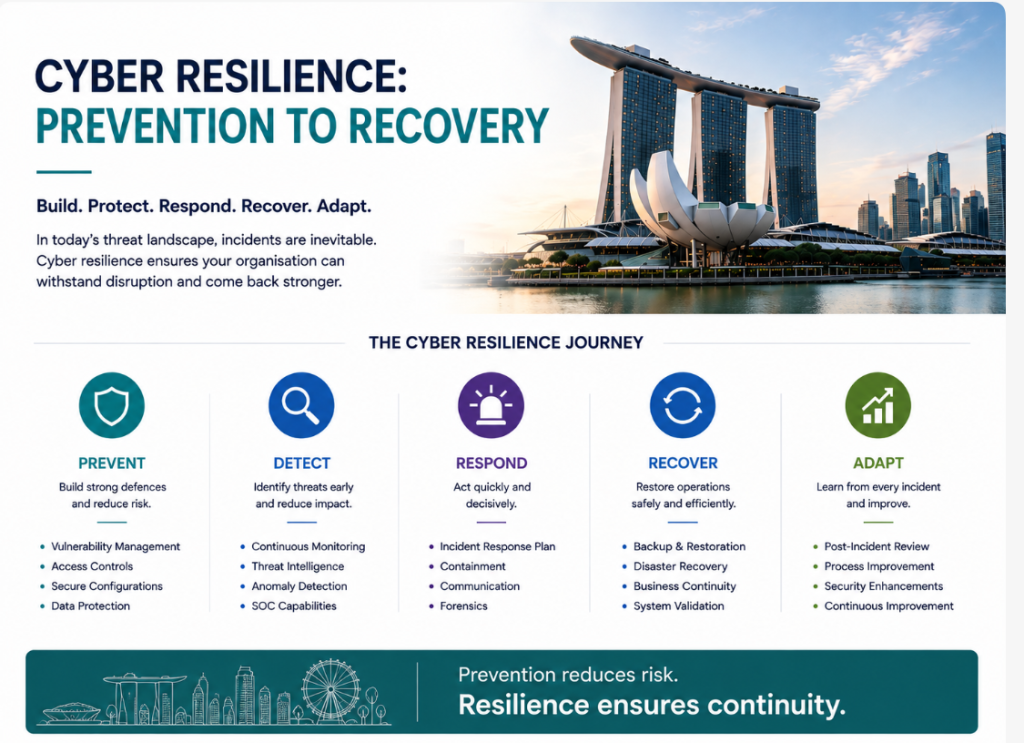
Why Organisations Must Prepare for the Full Cyber Incident Lifecycle
Cybersecurity has traditionally focused on one primary objective: prevent the attack.
Organisations invest in firewalls, endpoint protection, vulnerability management, security monitoring, employee awareness, and other preventive controls to keep attackers out. But in today’s rapidly evolving threat landscape, prevention alone is no longer enough.
The more important question is:
What happens when prevention fails?
A resilient organisation is not one that assumes it will never be attacked. It is one that is prepared to prevent, detect, respond, recover, and adapt when an incident occurs.
This is the essence of cyber resilience.
The Shift from Cybersecurity to Cyber Resilience
Cybersecurity and cyber resilience are closely connected, but they are not the same.
Cybersecurity focuses largely on protecting systems, networks, applications, and data from threats. Cyber resilience takes a broader view — ensuring that an organisation can continue critical operations, respond effectively to disruption, recover quickly, and learn from an incident.
This distinction is increasingly important as organisations become more dependent on cloud platforms, digital services, connected devices, third-party providers, and increasingly complex technology environments.
Singapore’s Cyber Security Agency (CSA) has highlighted the growing complexity, speed and sophistication of cyber threats, including the increasing use of artificial intelligence and the continued threat of ransomware. citeturn0search5turn0search6
The goal, therefore, should not simply be:
“How do we stop every attack?”
It should be:
“How do we remain operational and recover effectively when an attack succeeds?”
The Five Stages of Cyber Resilience
A strong cyber resilience strategy can be viewed as a continuous lifecycle.
1. PREVENT — Build Strong Defences
The first layer of resilience is prevention.
Organisations should identify their most critical assets, understand their vulnerabilities, reduce unnecessary exposure, and establish appropriate security controls.
Key priorities include:
- Regular vulnerability assessments and penetration testing
- Patch and vulnerability management
- Strong identity and access management
- Multi-factor authentication
- Endpoint and network protection
- Secure cloud configurations
- Data encryption
- Regular and secure backups
- Employee cybersecurity awareness
Prevention reduces the probability of a successful attack, but it cannot eliminate risk completely.
2. DETECT — Identify Threats Early
The longer an attacker remains undetected, the greater the potential damage.
Effective detection requires organisations to continuously monitor their digital environment and identify unusual activity before it becomes a major incident.
Security monitoring, endpoint detection and response, threat intelligence, log analysis, and Security Operations Centre (SOC) capabilities can help organisations identify suspicious behaviour and respond earlier.
Detection is particularly important because modern attacks may not immediately look like an obvious breach. Attackers can use compromised credentials, legitimate administrative tools, or trusted applications to move through an environment.
The earlier an organisation detects an incident, the more options it has to contain it.
3. RESPOND — Act Quickly and Decisively
When an incident occurs, every minute matters.
An organisation should not be creating its response strategy for the first time while an attack is already underway.
A well-defined incident response plan should establish:
- Who is responsible for making decisions?
- Who communicates with employees, customers, partners and regulators?
- Which systems should be isolated?
- How should compromised accounts be handled?
- Who investigates the incident?
- When should external experts be engaged?
- How will business operations continue?
Singapore’s CSA provides incident response checklists and playbooks covering scenarios such as ransomware, malware infections, business email compromise, DDoS attacks and cloud incidents.
But having a document is not enough.
Response plans need to be tested.
Tabletop exercises, simulations and cyber drills allow organisations to identify gaps before a real incident exposes them.
4. RECOVER — Restore Operations Safely
Recovery is where cyber resilience becomes especially important.
The objective is not simply to bring systems back online as quickly as possible. Organisations must ensure that systems are restored safely and reliably without allowing the attacker to regain access.
A strong recovery strategy should consider:
- Secure backup and restoration procedures
- Disaster recovery capabilities
- Business continuity planning
- Recovery Time Objectives (RTO)
- Recovery Point Objectives (RPO)
- System validation before restoration
- Post-incident monitoring
- Communication with affected stakeholders
Singapore’s cybersecurity guidance emphasises the importance of business continuity and disaster recovery planning, including defining RTOs and RPOs and exercising recovery procedures periodically.
For organisations operating critical digital services, recovery is not simply an IT responsibility.
It is a business continuity responsibility.
5. ADAPT — Learn and Strengthen
The final stage is often overlooked.
After an incident has been contained and systems restored, organisations need to ask:
Why did this happen?
How did the attacker gain access?
What controls failed?
What could have detected the activity earlier?
What needs to change?
A post-incident review should turn lessons learned into measurable improvements.
This could mean improving access controls, changing backup strategies, strengthening monitoring, updating policies, conducting additional employee training, or redesigning vulnerable systems.
Cyber resilience is therefore not a one-time project.
It is a continuous cycle of preparation, response, recovery and improvement.
Prevention Is Important — But Recovery Defines Resilience
One of the biggest misconceptions in cybersecurity is that a strong security posture means an organisation will never experience a breach.
In reality, even organisations with mature security controls can face sophisticated attacks, insider threats, supply-chain compromises, zero-day vulnerabilities or human error.
That is why resilience requires organisations to prepare for both the attack they hope never happens and the incident they must be ready to manage.
Singapore’s approach reflects this broader mindset. CSA’s current initiatives include strengthening defences before attacks occur while also supporting organisations with incident response and recovery capabilities.
Building a Cyber-Resilient Organisation
Organisations looking to strengthen cyber resilience should start with a practical assessment of five areas:
1. Know Your Critical Assets
Identify the systems, applications, data and services that are essential to business operations.
2. Understand Your Risks
Regularly assess vulnerabilities, attack surfaces, third-party dependencies and emerging threats.
3. Strengthen Detection
Establish continuous monitoring and ensure security alerts are investigated promptly.
4. Test Your Response and Recovery
Conduct tabletop exercises, incident simulations and disaster recovery tests.
5. Learn from Every Incident
Use incidents and near-misses as opportunities to improve security controls and organisational readiness.
The Future of Cybersecurity Is Resilience
Cyber threats will continue to evolve.
Artificial intelligence is changing how attackers operate. Ransomware remains a significant concern. Organisations are increasingly dependent on interconnected digital ecosystems, while supply-chain and third-party risks continue to expand.
In this environment, organisations cannot rely solely on prevention.
Cyber resilience means being prepared for the entire journey — from prevention to detection, response, recovery and continuous improvement.
The organisations that thrive in the face of cyber disruption will not necessarily be those that experience the fewest attacks.
They will be the ones that can detect faster, respond smarter, recover stronger and learn continuously.
Prevention reduces risk. Resilience ensures continuity.
The question every organisation should be asking today is not “Are we secure?”
It is:
“If tomorrow brings a cyber incident, are we ready to keep going?”