
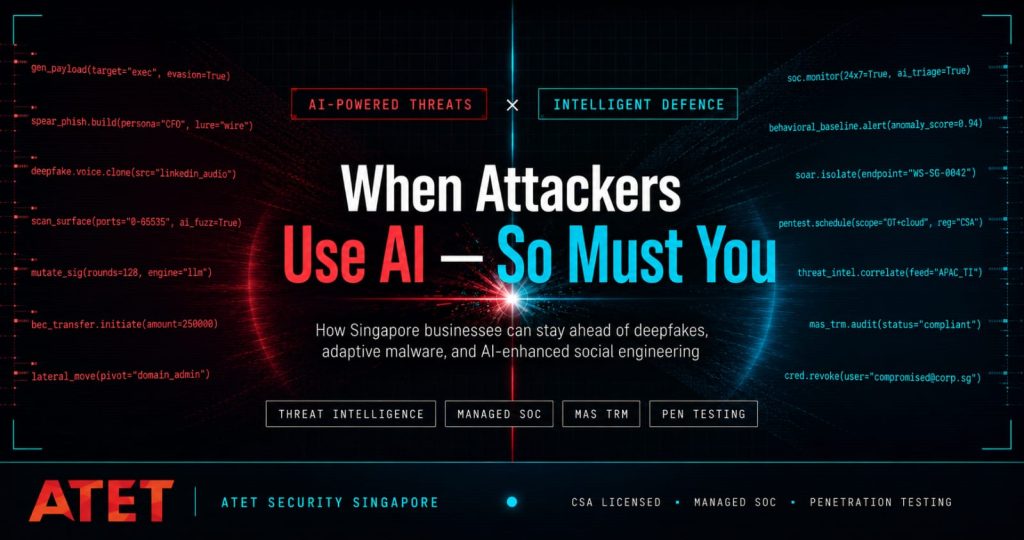
Artificial intelligence is transforming cybersecurity — but not only in the ways we hope. Alongside its enormous defensive potential, AI is now firmly in the hands of threat actors. Phishing emails with perfect grammar. Deepfake audio impersonating CEOs. Malware that rewrites its own code to evade detection. The threat landscape has shifted, and businesses operating in Singapore need to understand what that means for them.
This blog breaks down how AI is being weaponised by adversaries, what defenders can do in response, and why organisations in regulated industries — from financial services to critical infrastructure — cannot afford to stand still.
The Evolving Threat: AI-Powered Attacks
For years, cybersecurity defenders enjoyed a subtle advantage: volume. Attackers had to spray campaigns broadly to succeed. Poorly written phishing emails, generic malware, and clumsy intrusion attempts left digital fingerprints. That advantage is eroding.
AI-powered attack tools now enable:
• Hyper-personalised phishing: Large language models can generate contextually accurate, grammatically flawless spear-phishing emails at scale, tailored to an individual’s role, organisation, and recent activity scraped from LinkedIn or company websites.
• Voice and video deepfakes: Threat actors have used AI-cloned voices to impersonate senior executives in business email compromise (BEC) scams, successfully authorising fraudulent wire transfers.
• Adaptive malware: AI-assisted tools can modify malware signatures in near real-time, allowing them to evade traditional antivirus detection and even some next-generation endpoint solutions.
• Automated vulnerability discovery: Tools powered by machine learning can scan exposed attack surfaces and identify exploitable weaknesses far faster than human operators.
These are not theoretical scenarios. Incidents involving AI-enhanced social engineering have been documented in Southeast Asia, and Singapore’s position as a regional financial hub makes it a high-value target.
What AI Means for Singapore’s Regulatory Landscape
Singapore’s regulators have not been idle. The Monetary Authority of Singapore (MAS) Technology Risk Management (TRM) Guidelines and the Cybersecurity Agency of Singapore (CSA) are both actively evolving frameworks to address AI-related risks.
Key regulatory considerations include:
• Third-party and supply chain risk: AI tools and models embedded in vendor products expand your attack surface. MAS TRM explicitly requires financial institutions to assess third-party technology risks.
• Incident detection and response: The CSA’s Operational Technology (OT) Cybersecurity Masterplan underscores the need for detection capabilities that keep pace with sophisticated, automated threats.
• Model risk governance: Organisations deploying AI for security operations must manage the risk of adversarial inputs, model drift, and false negatives — a gap that regulators are beginning to scrutinise.
• Data protection under PDPA: AI-driven security tools that process personal data must comply with the Personal Data Protection Act, including breach notification obligations.
Compliance is no longer a box-ticking exercise. It is becoming a baseline defence capability.
Defending with AI: The Case for Intelligent Security Operations
The same technology that empowers attackers can be deployed in defence — and must be, given the speed and scale of modern threats. AI-augmented security operations offer several critical advantages:
Faster threat detection
Traditional SIEM platforms generate enormous volumes of alerts, many of which are false positives. AI-driven behavioural analytics can correlate signals across endpoints, network traffic, and identity logs to surface genuine threats far faster — often in seconds rather than hours.
Predictive threat intelligence
Machine learning models trained on threat intelligence feeds can identify emerging attack patterns before they hit your perimeter, enabling proactive hardening of the most likely targets.
Automated response and containment
Security orchestration and automation platforms (SOAR) powered by AI can isolate compromised endpoints, revoke credentials, and contain lateral movement without waiting for human approval — critical when dwell time is measured in minutes.
Continuous attack surface monitoring
AI-assisted penetration testing and red team simulations can continuously probe your environment for exploitable gaps, surfacing vulnerabilities before adversaries find them.
What Should Organisations Do Now?
There is no single solution to AI-enhanced threats. But organisations can take meaningful steps today:
• Reassess your threat model: If your security strategy was built before generative AI became mainstream, it needs a review. Social engineering assumptions, in particular, require updating.
• Invest in Managed SOC capabilities: A Security Operations Centre with AI-augmented monitoring provides the 24/7 visibility and response speed that in-house teams often cannot match.
• Conduct regular penetration testing: Understand your exploitable attack surface before attackers do. ATET Security Singapore holds a CSA licence for penetration testing services tailored to Singapore’s regulatory context.
• Train your people: Technical controls alone are insufficient. Employees who understand how AI-enhanced phishing works are a critical line of defence.
• Review vendor AI risk: Scrutinise the security posture of any vendor whose AI tools touch your environment, particularly those handling sensitive or regulated data.
Closing Perspective
AI will not resolve the cybersecurity challenge — it will intensify it. The organisations that will fare best are those that understand the threat landscape clearly, invest in intelligent detection and response capabilities, and meet their regulatory obligations as a floor, not a ceiling.
ATET Security Singapore exists to help organisations in this region do exactly that. As a licensed cybersecurity service provider under the CSA, we bring both the technical capability and the regulatory context required to protect Singapore’s businesses in an AI-accelerated threat environment.
Get in touch to discuss how ATET Security Singapore can support your organisation’s security posture.